Accelerate Productivity in 2025: Reignite Growth Despite the Global Slowdown
As we look towards 2025, businesses are faced with the pressing challenge of reigniting growth in a landscape shaped by global economic downturns. Leveraging technology—particularly in the semiconductor sector—has emerged as a crucial strategy for elevating productivity and efficiency across industries.
Executive Summary: Top 10 Semiconductor Technology Trends for 2026 & Beyond
The semiconductor industry is set to undergo transformative changes that will redefine technology landscapes. Below are the critical trends to watch as we advance into 2026.
1. AI Compute & Custom Silicon
The drive for efficient computing systems is pushing cloud providers and enterprises toward custom silicon designs. Companies like NVIDIA reported a staggering $39.1 billion in revenue from data centers in Q1 FY26, marking a 73% year-over-year increase. The shift to specialized AI accelerators exemplifies how adapting technology can yield substantial financial results.
2. Chiplets, 3D IC, & Advanced Packaging
The industry is aggressively expanding CoWoS (Chip-on-Wafer-on-Substrate) production. Market experts predict a capacity increase to approximately 75,000 wafers per month by 2025. This trend underscores the growing importance of advanced packaging technologies as demand for chiplets rises, catering to high-performance applications across sectors.
3. High Bandwidth Memory (HBM) & Memory-Centric Architectures
As AI technology matures, High Bandwidth Memory has become an essential component, accounting for 20% of DRAM revenue. The transition towards memory-centric architectures will only accelerate as HBM continues to dominate high-performance computing structures.
4. Automotive Chips
The integration of semiconductors in vehicles is anticipated to exceed $2,000 in silicon content per unit by mid-decade. With safety requirements evolving, regulatory bodies are pushing for enhanced electronic circuitry in vehicles, providing a substantial growth avenue for semiconductor manufacturers.
5. 2 nm Race & Angstrom-Class Roadmaps
Innovations are progressing in nanotechnology, with TSMC set to achieve 2 nm production by late 2025 and Intel aiming for advanced architectures at 1.8 nm. This race for smaller, more efficient chips is pivotal for industries seeking competitive advantages through performance and energy efficiency.
6. Supply Chain Geopolitics & Re-Shoring
Geopolitical tensions are reshaping the semiconductor landscape, particularly as the U.S. invests heavily in domestic manufacturing. Projected investments are set to exceed $30 billion across various firms, contributing to a fragmented supply chain that may mitigate risks associated with overseas dependencies.
7. Photonic & Quantum Integration
Advancements in photonic technologies and quantum computing are progressing from theoretical models to real-world applications. Innovations such as NVIDIA’s Spectrum-X Photonics targeting high-speed data transfer capabilities are redefining speed and efficiency in data centers.
8. Edge AI & Domain-Specific Processors
The proliferation of AI-capable devices at the edge is becoming commonplace. The forecast suggests that AI PCs will make up 57% of shipments by 2026. Companies are racing to deliver tailored solutions that leverage machine learning to optimize performance in various applications.
9. Wide-Bandgap Power (SiC & GaN)
Silicon Carbide (SiC) and Gallium Nitride (GaN) technologies are becoming mainstream, particularly in electric vehicles and data centers. The market is experiencing significant growth driven by demand for efficient power solutions across multiple sectors.
10. Sustainability
The semiconductor industry faces scrutiny over its environmental impact, with significant water and energy consumption. The push for sustainable practices is becoming integral, with organizations like TSMC targeting substantial renewable energy utilization by 2030. Innovations aimed at minimizing the environmental footprint are not just ideal but essential for the industry’s future viability.
Methodology: Creating the 2026 Semiconductor Trend Report
Our analysis stems from the proprietary StartUs Insights Discovery Platform, offering insights from over 7 million startups, alongside extensive patent data and market reports. Each trend report requires approximately 40 hours of diligent review, integrating both internal and external research methods to accurately highlight impactful developments in semiconductor technology.
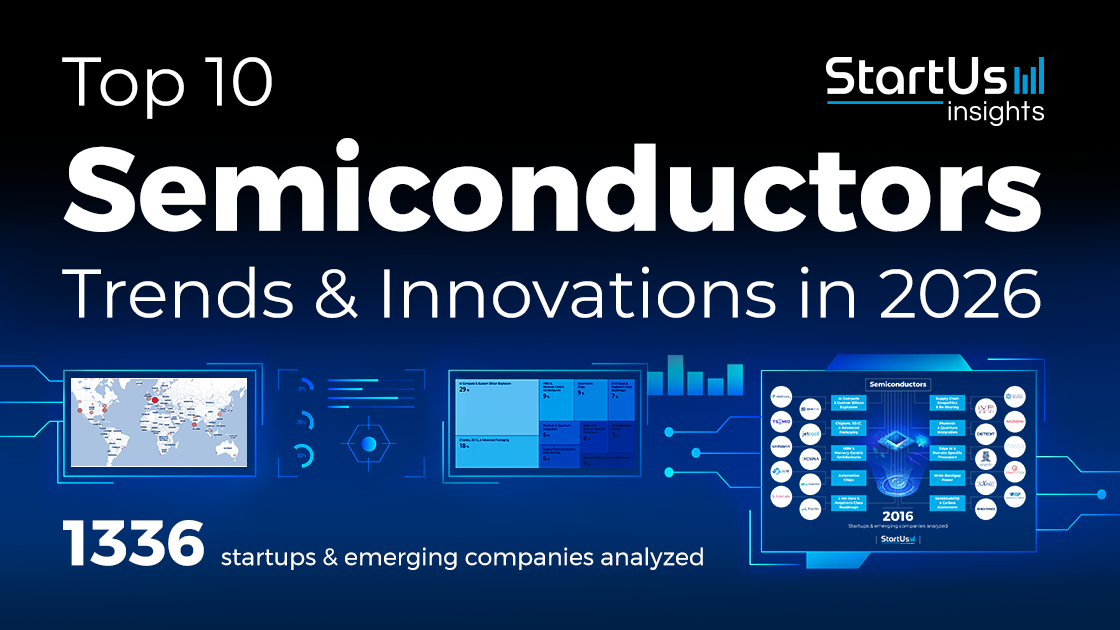
Innovation Map: Top 10 Semiconductor Industry Trends & Startups
The insights we’ve gathered also extend to innovative startups that align with each identified trend. The Semiconductor Innovation Map serves as a strategic tool for businesses to navigate potential partnerships and investment opportunities.
Frequently Asked Questions
1. What is the new technology for semiconductors?
Recent breakthroughs have led to the achievement of 3D-stacked DRAM utilizing advanced deposition techniques, which increase memory density and facilitate higher performance in computing tasks.
2. Who is leading in semiconductor technology?
TSMC continues to lead in advanced process nodes, while NVIDIA has emerged as a significant player in the AI semiconductor market. These firms, along with ASML for EUV systems, occupy key positions in the competitive landscape.
In summary, the semiconductor sector is poised for transformative progress, driven by technological innovations and a changing regulatory landscape. By staying informed about these trends, businesses can position themselves to thrive in the evolving market. As new technologies emerge and become integral to operational strategies, understanding these dynamics will be crucial in igniting growth through productivity in 2025 and beyond.