The Compound Effect: How Tech Entrepreneurs Build Wealth While Scaling Startups
Warren Buffett, an icon in the investing world, famously elucidated the importance of compound interest with the phrase: “Someone’s sitting in the shade today because someone planted a tree a long time ago.” This principle holds significant value, especially for tech entrepreneurs who often find themselves wrapped in the hustle of revenue growth and product development yet seldom pause to consider their personal wealth-building strategies.
Understanding how compound interest works can transform not only personal financial strategies but also impact business reinvestment decisions, solidifying a financial cushion regardless of the outcome of their startups.
The Magic of Compounding
At its core, compound interest allows money to grow exponentially; returns generate additional returns. The mathematical foundation may seem simple, but the implications are profound. For example, a $10,000 investment growing at a 10% annual return balloons to $25,937 in ten years, $67,275 in twenty, and a staggering $174,494 by the thirty-year mark.
When discussing compound interest, three main components deserve attention:
- Initial Principal: Larger starting amounts yield higher gains.
- Rate of Return: Small percentage differences can lead to significant long-term disparities.
- Time: The longer money compounds, the more dramatic the results.
Consider a scenario where an entrepreneur invests $50,000 in a diversified portfolio with an average annual return of 8%. After thirty years, that investment could grow to approximately $549,191, illustrating the powerhouse of time in wealth accumulation.
Personal Wealth Building for Founders
Tech entrepreneurs face a unique set of challenges related to wealth accumulation. Their income can fluctuate significantly, making it crucial to implement systematic strategies for wealth building.
Establishing a Safety Net
Before diving into aggressive investment strategies, it’s essential to lay the groundwork with an emergency reserve. A fund covering six months of living expenses can provide stability during lean times, enabling entrepreneurs to avoid forced liquidations of long-term investments.
Implementing a Systematic Investment Plan
Once the safety net is in place, establishing a systematic investment regimen becomes pivotal. Automatic transfers from checking accounts to investment accounts can foster consistent wealth growth. For example, investing $500 monthly at an 8% average return could yield approximately $298,073 after twenty years. The habit of consistent investing often outweighs the amount invested.
Tax-Advantaged Accounts
Maximizing contributions to tax-advantaged accounts enhances compounding potential. In the U.S., for instance, contributions to 401(k) and IRA accounts grow tax-deferred, while a Roth IRA grows tax-free. Understanding the nuances of these accounts can substantially impact long-term wealth.
The Compounding Effect on Business Strategies
Compound interest principles extend into business growth as well. Profits reinvested into the business can lead to revenue growth in the same manner as financial returns compound investment gains.
The Contrast of Two Startups
Imagine two hypothetical SaaS startups each generating $100,000 in monthly profit. Company A opts to distribute all profits to founders, while Company B reinvests a significant portion of its profits into growth initiatives. Over time, Company B’s strategic investments yield a monthly profit of $673,000, showcasing the compounding power of reinvested profits.
The Importance of Smart Reinvestment
To truly harness the benefits of reinvestment, it’s vital to measure the returns on each allocated dollar. Investments should yield tangible outcomes, whether that’s enhanced customer acquisition, improved product capabilities, or infrastructure upgrades. The growth strategy employed influences the extent to which these compounded gains manifest.
Startup Valuation and Compounding
A startup’s valuation can compound dramatically through successive funding rounds, reflecting the acceleration of growth. For instance, a company progressing from a $5 million seed round valuation to a $400 million Series C showcases the significant potential for compound growth.
Liquidity events play a crucial role in wealth creation. The earlier and more strategic the exits can be, the more robust the compounding effect. A founder exiting a company for $10 million at age 32, investing the proceeds, can see that grow significantly more than waiting for a larger exit a decade later.
Timing: The Essence of Compound Growth
The timing of contributions and liquidity events is one of the most critical factors in capitalizing on compound interest. Early investments tend to yield far greater returns than delayed ones. For instance, investing consistently from age 25 can create vastly different outcomes compared to starting at 35, even when total contributions are similar.
Consider two tech professionals: one begins investing at 25 and stops at 35, while the other waits until 35 to begin. Despite contributing far less, the early investor benefits significantly from the additional compounding years.
The Flip Side: Compounding Debt
While compounding can build wealth, it can also accelerate debt, particularly high-interest obligations like credit card debt. Understanding how compounding affects both ends of the financial spectrum is critical for entrepreneurs.
Practical Examples of Compounding Success
Real-world success stories highlight the importance of strategic, consistent investment. A mid-career tech professional maximizes retirement contributions while co-founding a startup, leveraging their early investments’ compounding nature to create substantial wealth over time.
In contrast, founders chasing large exits without prior investment often miss out on substantial financial growth due to the lost compounding years.
Using Compound Interest Calculators
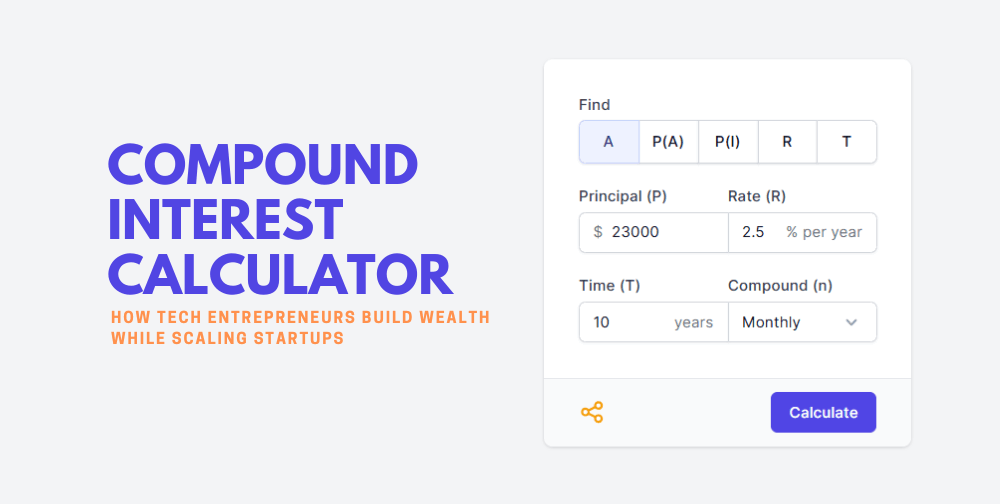
Harnessing the power of compound interest calculators allows individuals to visualize the long-term impact of their financial decisions. By analyzing various scenarios, founders can estimate the future value of their investments, helping them make informed investment choices.
The Decision That Compounds
The essence of compound interest transcends mere financial calculus; it serves as a decision-making framework. Each financial choice either compiles toward wealth or detracts from it. A tech entrepreneur should integrate compound thinking across personal wealth, business reinvestment, and startup equity decisions.
By understanding compound interest, starting early, and making thoughtful, consistent choices, tech entrepreneurs can build substantial wealth, proving that a successful financial journey doesn’t solely depend on monumental exits. Through discipline and the strategic application of compounding principles, financial success is accessible to all.